
Most Common 4-12 Month Sleep Questions, January 2026 Workshop
Before, during and after my 4-12 month sleep workshop, parents sent through a variety of questions regarding their little one’s sleep at this age. From those questions I compiled the most common ones and answered each in this blog post below. Only interested in a particular question? The table of contents is clickable, so just jump straight to the answer you’re looking for!
Table of contents
My Little House Of Sleep
Question #1: How can I get my little one to have longer naps?
Question #4: Should the sleep environments for daytime and nighttime be different?
Question #5: What does a good sleep routine look like for this age?
My Little House of Sleep
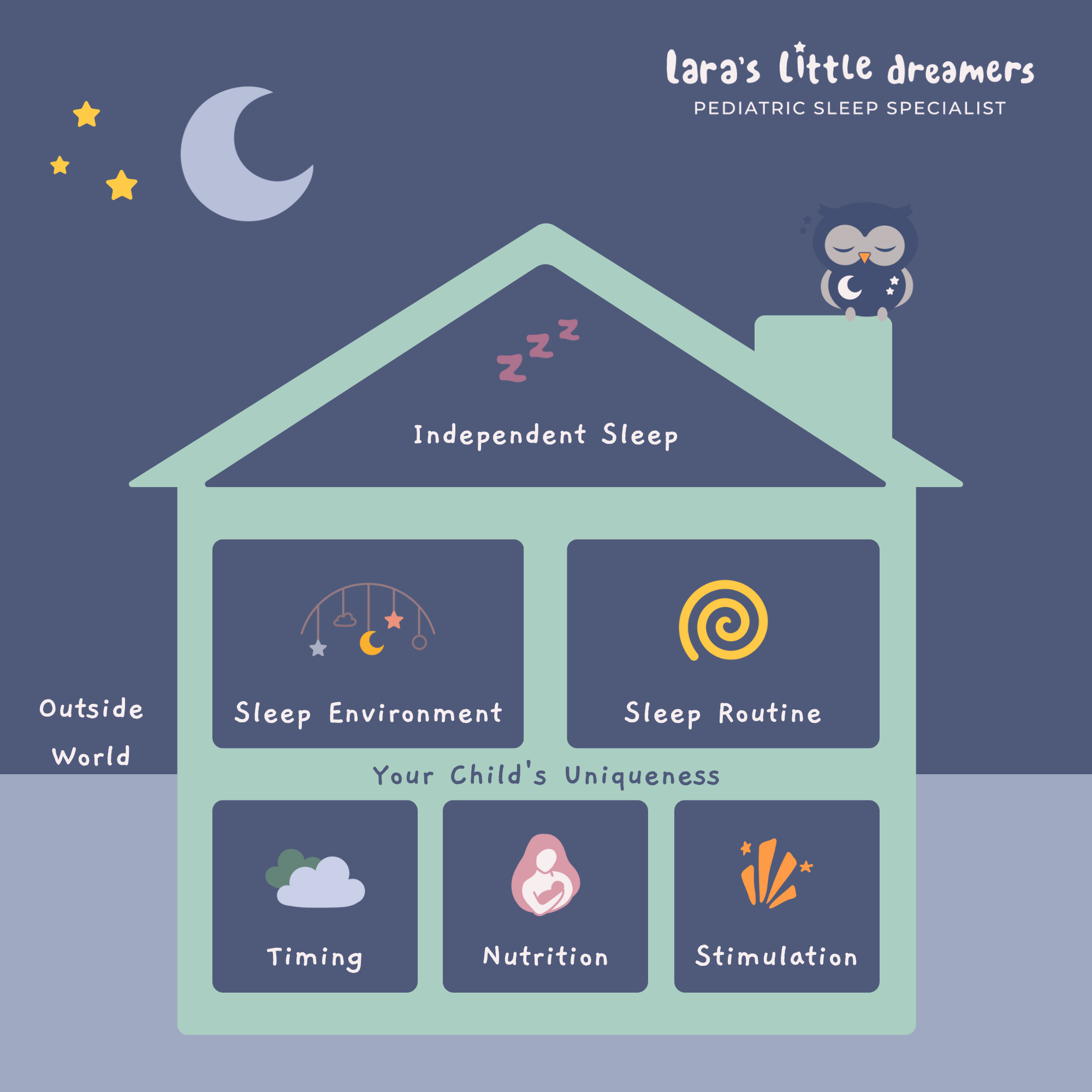
In case you forgot what the Little House Of Sleep looks like, this is it (and you can read more about it here)
Question #1: How can I get my little one to have longer naps?
Longer naps require your little one to connect sleep cycles. Good to know is that this is a skill that can be tricky to learn and it only becomes consistent after 6 months old. Before 6 months old even if your baby can connect sleep cycles, there still may be times that they have a short nap just due to where they are developmentally, and this is totally normal and okay.
Using the Little House of Sleep, the way in which a baby is able to learn to connect sleep cycles is by;
Timing: making sure your baby is going to sleep when they are ready – they have had enough awake time and stimulation to build good sleep pressure and are not over stimulated.
Nutrition: You know that they have recently had a good feed so hunger will not wake them.
Environment: limiting the distraction when they come to the end of 1 sleep cycle by having a dark room and sound machine on.
Independent sleep: starting to help your baby to fall asleep with little to no props or associations will mean that it will be much easier for them to connect sleep cycles. As your baby ends one sleep cycle their body will search for the support they had when falling asleep. They have “learnt” that falling asleep requires breast, rocking, carrying, etc. and so as their bodies want to move to the next sleep cycle this is what they look for to support them. By reducing and eventually removing these props or associations your baby will then fall asleep without those and threfore when they get to needing to connect to a new sleep cycle they do not look for external supports.
Regarding point 4 – this does not mean you need to immediately do sleep training (!), however I would recommend that you reduce the more attached support props like breast feeding to sleep and rocking to sleep. My recommendation is that you support your baby to sleep while they are in their own space, but you can be next to the crib, your hand constantly on them with rocking and shushing or singing. When they start to get close to a new sleep cycle you can go in and use the same support to help them connect. This level of support is fully attached, however they are still falling asleep in the same space they will be in through their sleep and slowly they will need less and less of the hand rocking and shushing.
This is a big step for many parents so take it slowly and at your own pace. Try and practice and if it is working, then pick them up, help them to sleep and try again at the next nap or next day. Trying and giving your little one the opportunity is the only way they will slowly be able to do it.
Question #2: How can I stop breast-feeding my little one to sleep or using breast-feeding as the only soothing technique?
The simple answer is to just stop and offer any other form of comfort and support. But that is easier said than done! The hard part about doing this is that this is the toughest association to stop for both baby and mama.
The best way to go about this is to make the decision that you want to stop breast-feeding to sleep and using the breast as a sleep support (and committing 100% to this), because going back and forth is more confusing for your baby and will ultimately make it harder each time. Once you commit it will be a couple of tough days, but after about 2 days there will be great progress.
The things to focus on for making this transition:
Nutrition: Focus on feeding every 3-4 hours during the day and ensuring full feeds at each feed. Stop offering snack feeds during the day that happen in between those 3-4 hours. If it is almost nap time and it has been about 2hr30min or 2hr45min then this is close enough to offer a full feed to ensure your baby does not wake from being hungry, otherwise feeds should always be 3-4 hours apart.
While making this change do not hold back on other forms of comfort and support for your baby both during awake time and sleep time. You can rock, sway, sing, use a pacifier, anything that can help you to soothe your baby. What is happening is they are now going to learn a new way to calm and to fall asleep and this takes time and practice. Most importantly, as I said before, once you commit stay to this and after 2 days there will be big progress already.
Remember, if your baby has been fed their fussing and crying is a form of them trying to tell you they do not like the change. There is no pain, there is no discomfort, it is just the rejecting change and as long as you continue to support in other ways you continue to show your connection and attachment. You are however just holding a new boundary that you are wanting them to learn. It can be tough, but it is worth it in the end.
Question 3: How can I cut down on multiple night wakings or get my little one sleep through the night?
Reducing night wake ups mainly relies on your little one connecting sleep cycles on their own and requiring no props.
Using the Little House of Sleep, the way in which a baby is able to learn to connect sleep cycles is by;
Timing: Your baby has had sufficient naps during the day ensuring enough to prevent being overtired and not too much day sleep to ensure good sleep pressure. Follow good awake windows through the day and cap naps where needed.
Nutrition: During the day focus on feeds being every 3-4 hours to ensure full feeds and maximise daily calorie intake. This also prevents snack feeding which means they become more used to feeds at longer intervals both day and night.
Stimulation: Make sure that your little one is getting enough stimulation through out the day – both cognitive and physical. Often our little ones do not get quite enough free movement during their awake times and this can make their bodies wrestless which can wake them through the night.
Environment: limit the distraction when they come to the end of 1 sleep cycle by having a dark room and sound machine on. This will help your little one to connect sleep cycles more easily and hence sleep longer stretches and reduce wake ups.
Independent sleep: starting to help your baby to fall asleep with little to no props or associations will mean that it will be easier for them to connect sleep cycles. As your baby ends one sleep cycle their body will search for the support they had when falling asleep. They have “learnt” that falling asleep requires breast, rocking, carrying, etc. and so as their bodies want to move to the next sleep cycle this is what they look for to support them. By reducing and eventually removing these props or associations your baby will then fall asleep without those and therefore when they get to needing to connect to a new sleep cycle they do not look for external supports.
Regarding point 5 – this does not mean you need to immediatley do sleep training however I would recommend that you reduce the more attached support props like breast feeding to sleep and rocking to sleep. My recommendation is that you support your baby to sleep while they are in their own space, but you can be next to the crib, your hand constantly on them hand rocking and shushing or singing. When they start to get close to a new sleep cycle you can go in and use the same support to help them connect. This level of support is fully attached, however they are still falling asleep in the same space they will be in throughout their sleep and slowly they will need less and less of the hand rocking and shushing.
This is a big step for many parents so take is slowly and at your own pace. Try and practice and if it is not working, then pick them up, help them to sleep and try again at the next nap or next day. Trying and giving your little one the opportunity is the only way they will slowly be able to learn (like with anything!).
Question #4: Should the sleep environments for daytime and nighttime be different?
Ultimately the environment should be the same for naps and nights when your baby is sleeping in their crib or cosleeper. During the time that you are trying to make changes in your baby’s sleep and helping them through these changes, it is best to do as many naps in the same sleep environment as night time. These conditions are what support better sleep habits and quality, and so while they are learning you are giving them the best opportunity to succeed.
In saying this, you can continue to do naps in the stroller or carrier naps, this is both good for your baby and for you. It is good for them so they continue to have flexibility in being able to nap outside of that “perfect” environment and good for you to still maintain those special naps together. So still have these naps, I always say the last nap of the day is always the toughest so doing your stroller or carrier nap for the last nap of the day is a good plan – easier on both of you.
Question #5: What does a good sleep routine look like at this age?
A good sleep routine should be about 20 - 30 minutes long at night and 15 – 20 minutes at nap time. It normally consists of about 8-10 steps, but what is important in the steps is that you move slowly, calmly and steadily between each one. Do not rush the routine, try to see this time as bonding time and to show your little one that sleep is a calm and enjoyable time.
An example of a sleep routine is:
Bath time
Baby massage
Pj’s and sleep-sack on
Dim the lights, white noise on
Read a book – nice and slowly, pointing at pictures and interacting with low energy
Chat time – things from the day, things you are grateful for, a little prayer
Lullaby
Good night or sleepy time phrase
Lights off
In bed
Can it be changed up a little if my baby is sleeping well?
Like I always say, the key to a good sleep routine is that the steps are followed consistently and in the same order every single time. Anyone can do the routine in their own voice, language, or combination, but it is important to follow the steps in the same order with the same level of calmness every time.
As your baby’s sleep starts to become consistent, they are really receptive to their routine and they are sleeping well, you can absolutely make adjustments or changes when needing to be flexible. If you are at someone else’s house and there is no bath, no problem. If you have less time one night and cannot do chat time, no problem. If you are traveling and don’t have as many products and cannot do the massage, no problem! These small changes will not negatively impact a baby that sleeps well, just try to get back to your “normal” as soon as you can.
Want to learn a little more or meet 1:1 to discuss your situation in more detail?
Have a look at the Little Dreamers 4-12 Month Toolkit or go ahead and Book A Free Quick Consult :)