
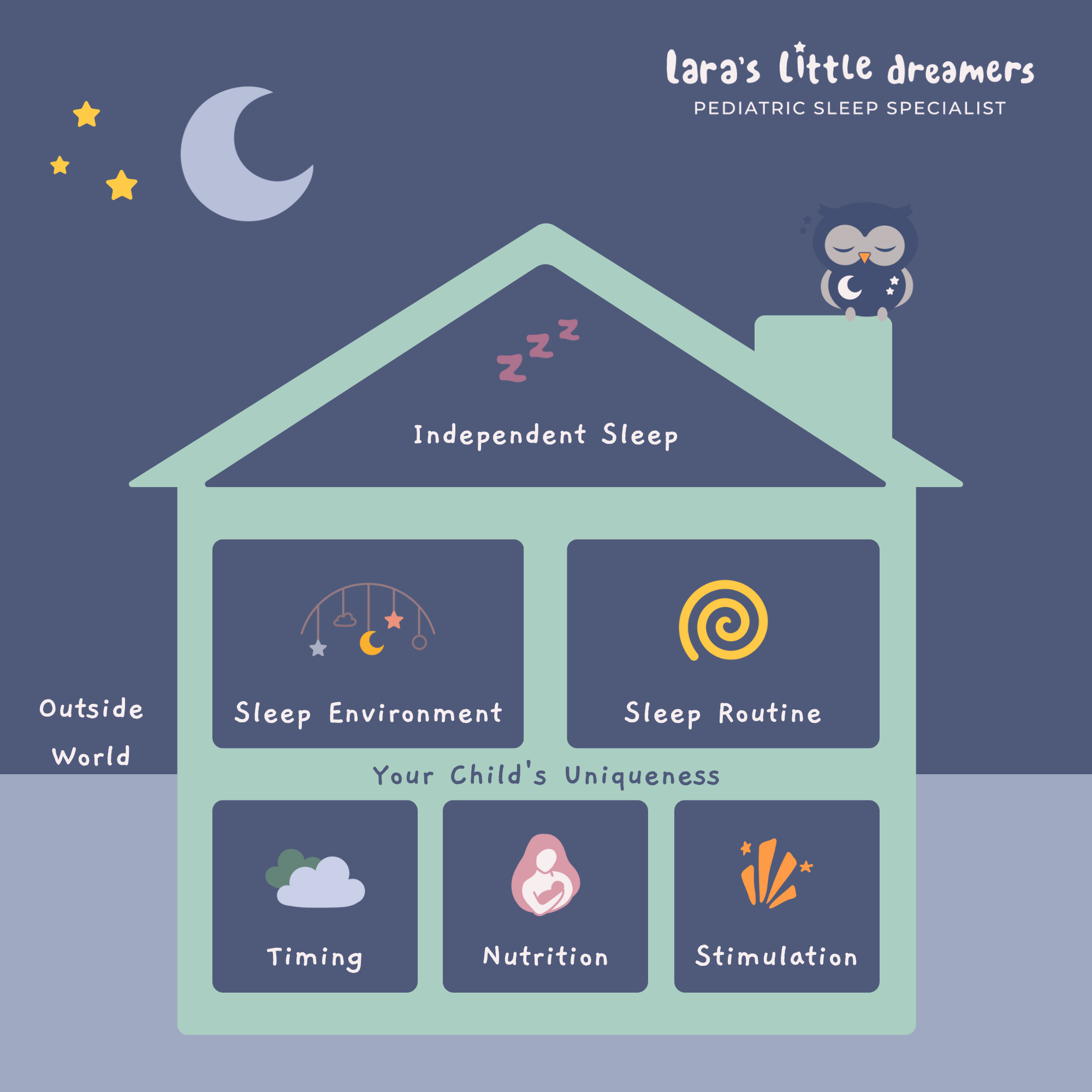
My Little House Of Sleep Model
After my studies and a few months of working with so many tired parents, I started noticing a pattern in how sleep is shaped in our little ones (and us as parents when you think about). What we know is sleep is not something that we can just decide to do and there are very, very few people who can go from fully awake and alert to dozing off on the couch in a matter of seconds. This is exactly the same for our children.
Sleep is an outcome of several factors with each factor playing a unique role and all of the factors together producing independent sleep. Long ago, our environments provided these factors naturally - today, it’s a little more difficult with all the artificial lighting, sound and stimulation we face on a day to day basis.
I realized that this is very similar to the way a house is built: from the ground up, on a solid foundation, each room playing its part and the overall strength allowing it to manage and thrive in the outside world.
I call this model of mine the Little House Of Sleep:
✔ The Foundation of the house: Timing, Nutrition, and Stimulation (mental and physical)
✔ The Rooms: Sleep Environment and Sleep Routine
✔ The Walls: your Child’s Uniqueness
✔ The Roof: Independent Sleep
✔ The Outside World: family, culture, travel, school, daycare, etc.
By understanding how all of this fits together, you can better understand your little one’s sleep and you can clearly (and quite easily) identify where sleep struggles are coming from, how to adapt and change what is necessary and therefore continue to help your little one on their sleep journey.
When looking at the different rooms of the house, we think about…
✔ Timing: Total Amount Of Sleep, Total Daytime Sleep, Number of Naps and Awake Windows
✔ Nutrition: Feed timing, Full Feeding, Feeding as Sleep Association
✔ Stimulation: Mental and Physical
✔ Sleep Environment: Safety, Darkness, Sound, Comfort
✔ Sleep Routine: Consistent Steps, Duration, Day vs Night routine
✔ Your Child’s Uniqueness: Individual preferences, Milestones, Temperament, Personality, Uniqueness as a strength
✔ Independent Sleep: Falling asleep, Staying asleep, Sleep training
✔ The Outside World: Family, Culture, Travel, School or Daycare, Life